South Florida Dog Trainer

The 30-Day Rescue Reset: How to Calm a Fearful Dog Without Losing Your Mind

Adopting a rescue dog is a commitment to providing safety and stability, but the transition period often requires significantly more patience and strategy than new owners anticipate.

When a fearful dog enters a new home, they are not immediately aware that they have been rescued. Instead, they are experiencing a complete disruption of their environment, routine, and sense of safety.
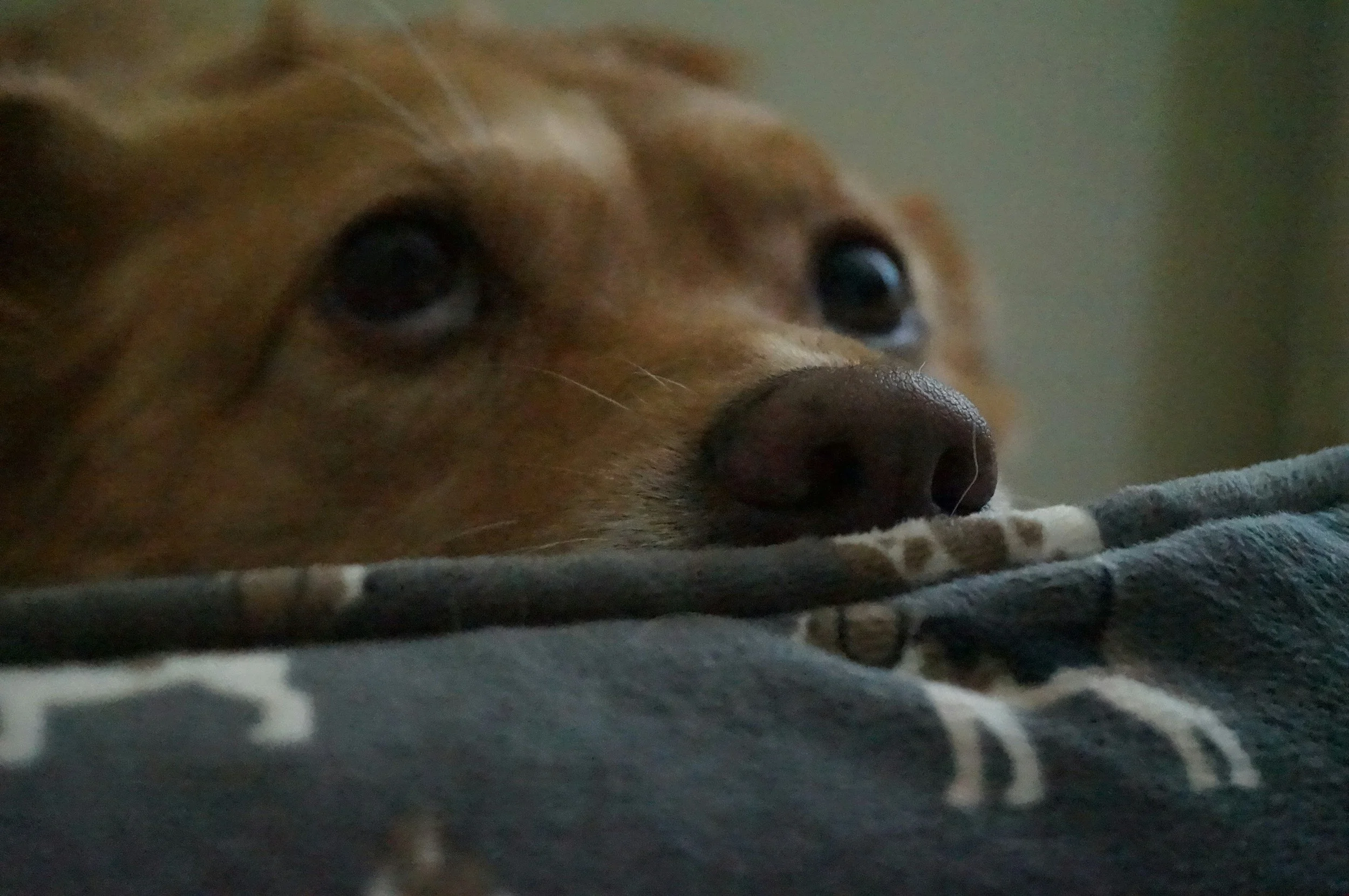
A newly adopted rescue dog peeking out from a safe hiding spot, illustrating early-stage rescue dog decompression and fear management.

For a dog prone to fear or anxiety, initial reactions often include hiding, hyper-vigilance, refusal to eat, or avoidance of human contact. At Canine Intuition Dog Training, we emphasize that building genuine trust is a deliberate, step-by-step process.

This guide outlines a clear, 30-day behavioral protocol designed to lower stress levels, establish security, and foster long-term confidence in a fearful rescue dog.

Understanding the Canine Reality: The 3-3-3 Rule

Before you try to bribe your terrified pup with expensive freeze-dried liver bites, you need to understand where their brain is at. To a fearful rescue dog, you aren't their savior yet; you are a giant, unpredictable predator holding a strange rope who brought them to an unfamiliar castle full of weird smells and loud noises.

Professional trainers rely on the 3-3-3 Rule as a realistic roadmap for canine decompression:

  • The First 3 Days: Feeling overwhelmed, anxious, and shut down. They may refuse to eat, hide, or test boundaries out of sheer panic.

  • The First 3 Weeks: Starting to settle in, learning your daily routine, and realizing they are safe—though their true personality (and bad habits) will start emerging.

  • The First 3 Months: Building genuine trust, feeling completely secure in their home, and bonding deeply with their family.

Trying to rush this process is like asking someone to solve complex calculus while riding a runaway rollercoaster. True confidence takes time.

Days 1–3: Decompression and Lowering the Cortisol Spike

The single biggest mistake well-meaning owners make during the first 72 hours is doing too much, too fast. Resisting the urge to host a welcome-home party for your neighbors is crucial.

  • Create a "Safe Cave": Designate a quiet room or corner away from foot traffic. Place a secure crate covered with a blanket (leave the door open if they aren't crate-trained yet), an orthopedic bed, and a water bowl. When they are in their safe zone, human interaction stops completely.

  • Master the Art of Ignoring Your Dog: It sounds counterintuitive, but ignoring a fearful dog is the highest form of respect you can show them. Avoid direct eye contact, towering over them, or reaching out to pet them. Let them observe you navigating your home without feeling pressured to interact.

  • Minimize Environmental Stimuli: South Florida presents a unique barrage of triggers—blaring air conditioners, sudden afternoon thunderstorms, pool pumps, and buzzing lawn care crews. Keep your home quiet. Soft music or white noise can drown out sudden household sounds while your dog's stress hormones slowly drop.
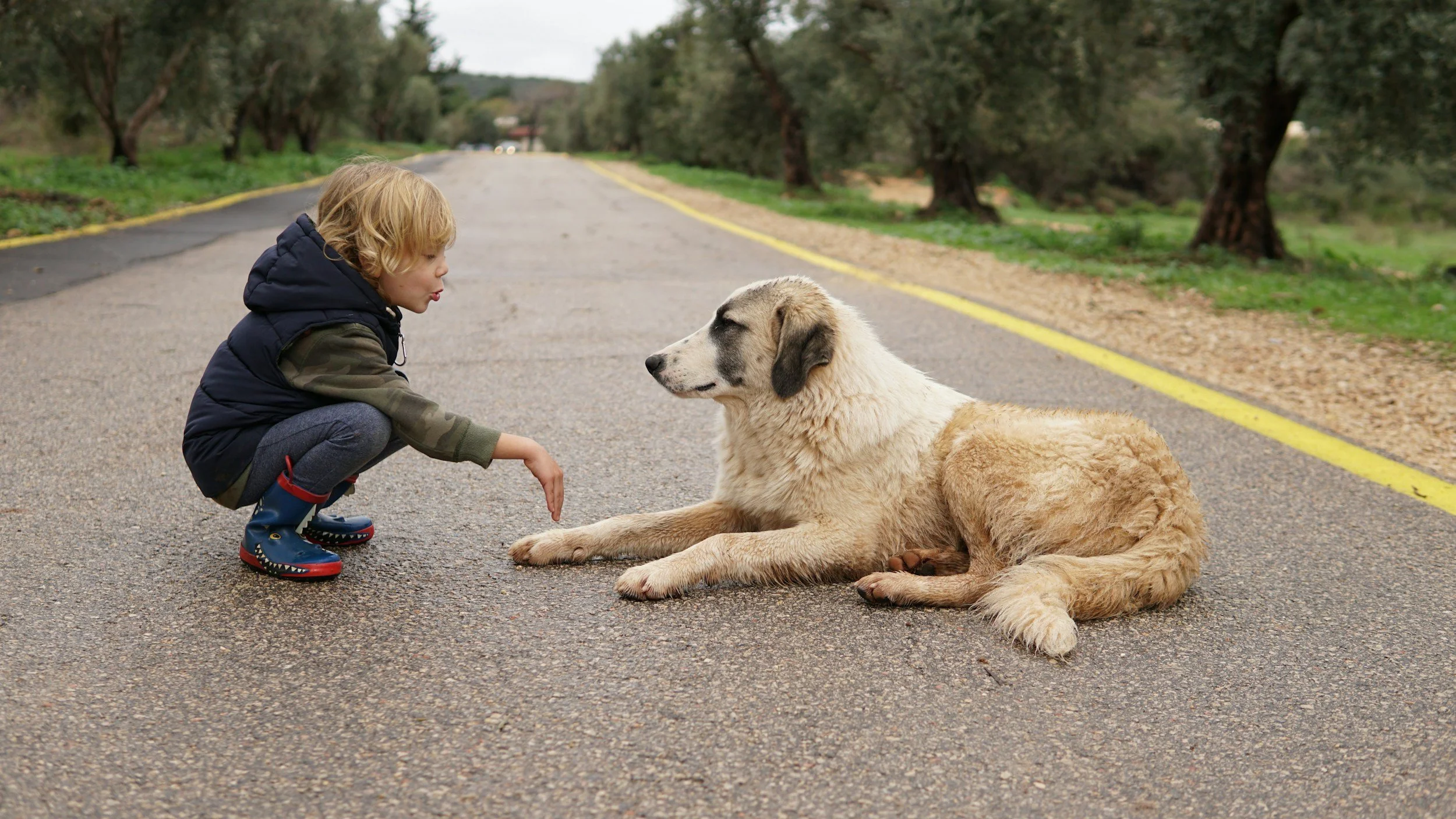
A dog owner practicing low-pressure hand feeding with a cautious rescue dog to build trust in a South Florida home.

Days 4–14: Establishing Predictable Routines

Fear thrives in uncertainty. Structure creates security. Once your rescue dog realizes that their daily life is completely predictable, their nervous system finally shifts out of fight-or-flight mode.

  • The Power of the Clock: Feed your dog, walk them, and crate them at the exact same times every day. When a dog knows precisely when their next meal is coming and when they will be taken out to potty, their internal anxiety dial drops significantly.

  • Drag-Leash Protocol for Safety: If your rescue dog is skittish, trying to corner them to clip on a leash for potty breaks will destroy trust instantly. Attach a light, handle-free drag leash to their collar inside the house. If you need to move them, simply pick up the end of the leash calmly without hovering over them.

  • Low-Pressure Hand Feeding: Ditch the food bowl for half of their daily meals. Sit on the floor sideways (never facing them directly), toss small bits of high-value kibble or treats near them, and look away. Let them approach the food on their terms.

Helpful Trust Builders vs. Accidental Anxiety Boosters
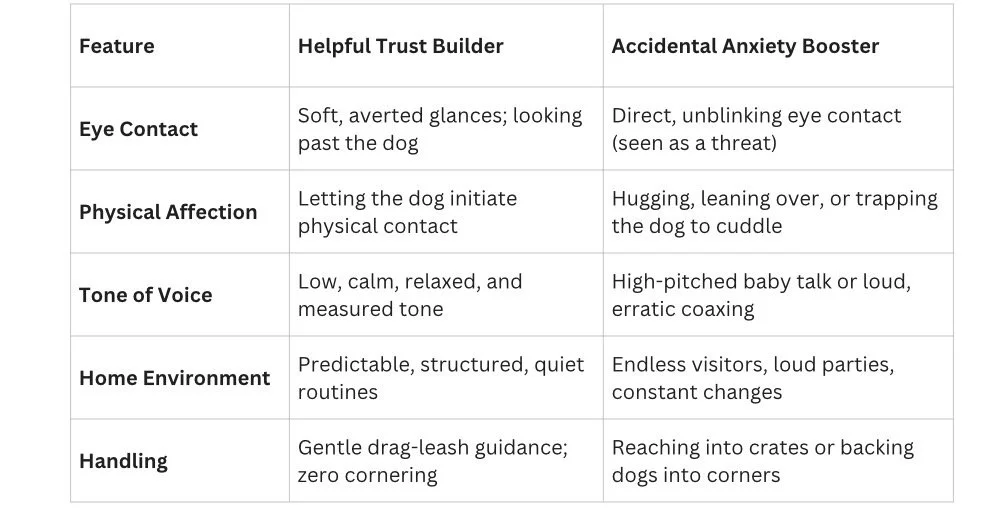
A helpful chart  detailing helpful trust builders for your rescue dog

Days 15–30: Micro-Exposures and Building Real Confidence

By week three, your dog's true personality will begin to shine. Now that baseline trust is established, you can gently expand their world without overwhelming their progress.

  • Controlled Micro-Exposures: Introduce new experiences in tiny, bite-sized pieces. If your dog is terrified of the sliding glass door leading to the patio, don't force them outside. Reward them simply for looking at the door, then for standing two feet away, and eventually for stepping one paw outside onto the patio.

  • Confidence-Building Obstacle Courses: Use safe, everyday items to teach problem-solving. Place a treat under a folded towel, or let them navigate around a cardboard box. Overcoming small physical challenges builds mental resilience and teaches them to look to you for encouragement.

  • Calm Loose-Leash Explorations: Avoid high-volume areas like crowded South Florida dog parks or busy outdoor malls. Stick to quiet suburban sidewalks in Broward or Palm Beach during off-peak hours. Allow them to sniff thoroughly; sniffing is a natural, calming behavior that lowers a dog's heart rate.

When to Call Certified Master Trainers

Love, patience, and rotisserie chicken can solve 80% of rescue dog jitters. But when fear manifests as extreme resource guarding, severe separation distress, or fear-based aggression (growling, snapping, or lunging), attempting DIY behavioral modification can put you and your dog in danger.

At Canine Intuition Dog Training, we bring 20 years of certified experience to help owners navigate complex behavioral cases safely. We evaluate your dog's unique temperament, identify environmental triggers, and build a custom, balanced roadmap that converts fear into lasting confidence.

Trust is built in drop-by-drop increments, but it can be lost in bucketfuls. By providing clear boundaries, unconditional patience, and structured guidance during these critical first 30 days, you aren't just rescuing a dog—you are giving them the gift of true peace of mind.
Ready to help your rescue dog thrive?

Serving Broward and Palm Beach counties with two decades of certified master-level expertise, Canine Intuition Dog Training helps fearful dogs step into confidence.

Contact our team today to schedule a professional evaluation!

Tame the Energy: 15 Impulse Control Exercises for High-Energy South Florida Dogs

Living in South Florida with a high-energy dog is a double-edged sword. On one hand, we have year-round sunshine, vibrant coastal parks, and endless dog-friendly dining from Atlantic Avenue in Delray Beach to Las Olas Boulevard in Fort Lauderdale. On the other hand, a hyperactive, impulsive dog can make enjoying these local perks nearly impossible.

Whether your pup explodes through the front door, bolts after iguanas along the Intracoastal, or jumps on outdoor restaurant guests in Boca Raton, the root cause is rarely a lack of love or exercise. The true issue is a lack of impulse control.

Impulse control is a dog’s ability to resist immediate temptations, manage emotional arousal, and make thoughtful decisions rather than acting on instinct.

While physical exercise drains a dog's muscles, impulse control exercises train their brain. For high-energy breeds—like German Shepherds, Malinois, Border Collies, Vizslas, and energetic pit mixes—mental workouts are far more effective at producing a calm, settled companion.

Here is your ultimate guide to 15 field-tested impulse control exercises tailored specifically for high-energy dogs navigating the fast-paced, distraction-filled environment of South Florida.

High-energy golden retriever practicing calm impulse control at an outdoor patio in Boca Raton, Florida

Understanding Canine Impulse Control: Arousal vs. Obedience

Before diving into the exercises, it is crucial to understand that impulse control is different from basic obedience. Obedience teaches a dog what to do when instructed (e.g., "Sit," "Down"). Impulse control teaches a dog how to regulate their emotional arousal in high-stakes environments without waiting for a constant stream of commands.

When a high-energy dog sees a squirrel, a passing golf cart in Lighthouse Point, or another dog on the Deerfield Beach Boardwalk, their brain shifts from the prefrontal cortex (thinking) to the amygdala (emotional reaction). Impulse control exercises build emotional endurance, allowing your dog to stay in a "thinking" state even when excited.

15 Step-by-Step Impulse Control Exercises

1. The Default Sit ("May I Please?")

Objective: Teach your dog that offering automatic eye contact and a sit is the universal key to getting what they want.

How to Train:

  1. Stand in front of your dog with a piece of kibble or a toy held at your chest. Do not say a word.

  2. Your dog will likely jump, paw, or bark to get it. Ignore these behaviors completely.

  3. The moment your dog sits and looks up at your eyes, say "Yes!" (your marker word) and reward them immediately.

  4. Repeat this until your dog approaches you and automatically sits without being asked.

South Florida Application: Practice this before putting on their walking harness before heading out to Quiet Waters Park in Deerfield Beach.

2. The Zen Bowl (Food Bowl Patience)

Objective: Prevent mealtime frenzy and build patience around high-value food rewards.

How to Train:

  1. Hold your dog’s food bowl at chest level while your dog is in a sit.

  2. Begin slowly lowering the bowl toward the floor.

  3. If your dog breaks their sit or lunges toward the bowl, immediately raise it back up to your chest.

  4. Repeat until you can place the bowl flat on the floor while your dog remains patiently seated.

  5. Release them with a clear verbal cue like "Break!" or "Free!" before they eat.

Trainer practicing the Zen Bowl impulse control exercise with a Belgian Malinois indoor

3. Threshold Control (Doorways and Gates)

Objective: Eliminate door-bolting for safety around busy South Florida streets and pool decks.

How to Train:

  1. Approach your front door, backyard patio slider, or pool gate with your dog on a leash.

  2. Ask for a "Sit" and place your hand on the doorknob.

  3. Crack the door open an inch. If your dog lunges or stands up, immediately snap the door shut (safely away from paws).

  4. Repeat opening the door gradually. The door opens only when the dog is calm and still.

  5. Step through the doorway first, then release your dog to follow.

Local Benefit: Crucial for waterfront homes in Lighthouse Point and Fort Lauderdale where open doors lead directly to canals or busy roads.

4. High-Value "Leave It" (From Treats to Florida Iguanas)

Objective: Teach a rock-solid disengagement command for off-limit items.

How to Train:

  1. Place a low-value treat in your closed fist and present it to your dog.

  2. Let them sniff, lick, or nuzzle your hand. Say nothing.

  3. As soon as your dog backs away or turns their head, mark "Yes!" and reward them with a different, higher-value treat from your other hand.

  4. Graduate to placing treats on the floor covered by your shoe, then uncovered.

  5. Transition to moving objects like rolling balls, and eventually live distractions like lizards.

5. Curb Waiting on Busy Avenues

Objective: Teach your dog to automatically stop at every sidewalk curb before crossing.

How to Train:

  1. Walk toward a curb on a quiet residential street in Pompano Beach or Boca Raton.

  2. As your feet reach the edge of the pavement, stop moving and wait for your dog to sit automatically.

  3. Do not step off the curb until your dog gives you eye contact.

  4. Mark "Yes!" and proceed across the street together.

  5. Practice this at every single intersection during your daily neighborhood walks.

Pitbull waiting patiently at a street curb during a walk in Delray Beach, Florida

6. The Flirt Pole Settle (High-Arousal On/Off Switch)

Objective: Teach emotional regulation when your dog’s adrenaline and drive are at peak levels.

How to Train:

  1. Use a flirt pole (a long wand with a toy attached to a rope) and entice your dog into a fun game of chase.

  2. Let your dog catch the toy and play briefly.

  3. Ask your dog to "Drop it" or freeze the pole entirely so the fun stops.

  4. Ask for a "Sit" or "Down." The moment their hips hit the ground and they calm down, say "Get it!" and start swinging the flirt pole again.

  5. This teaches your dog that staying calm is what restarts the fun.

7. The "Place" Command on Outdoor Patios

Objective: Create a relaxed, stationary behavior on a designated mat or towel.

How to Train:

  1. Place a portable bath mat or cooling pad on the floor.

  2. Lure your dog onto the mat with a treat, bringing all four paws onto the target area.

  3. Say "Place," reward them with multiple treats while they stay on the mat, and release them.

  4. Extend the duration from 5 seconds up to 30 minutes over several weeks

  5. Introduce heavy distractions (e.g., dropping toys, having family members walk past).

South Florida Tip: Bring your dog’s foldable "Place" mat to outdoor cafes along Atlantic Avenue in Delray Beach or Las Olas Boulevard in Fort Lauderdale so they lie down quietly while you dine.

8. Interactive Fetch with Mandatory "Sit-Stay"

Objective: Turn a standard game of fetch into a powerful brain-building impulse control session.

How to Train:

  1. Hold your dog's favorite ball or toy.

  2. Require your dog to sit and hold a stay before you throw the ball.

  3. Throw the ball while your dog remains in the stay position.

  4. Wait 3 to 5 seconds while the ball settles.

  5. Give your release cue ("Fetch!" or "Go!") so your dog dashes after the ball only on your terms.

High-energy Labrador Retriever holding a stay position before chasing a ball in a park in Pompano Beach

9. Tug and Release (Teaching Control During Play)

Objective: Build quick-response compliance during high-intensity physical engagement.

How to Train:

  1. Engage in an energetic game of tug-of-war using a sturdy rope toy.

  2. Suddenly freeze your body and hold the tug toy completely still against your leg.

  3. Cue a gentle "Out" or "Thank you." Hold a treat near your dog's nose if necessary to prompt a release.

  4. The moment your dog lets go, mark "Yes!", ask for a brief "Sit," and immediately reward them by restarting the game of tug.

10. The Four-on-the-Floor Greeting Protocol

Objective: Eliminate jumping on family members, house guests, and strangers.

How to Train:

  1. Have a friend or family member approach your dog on a leash.

  2. If your dog begins to pull, jump, or whine, have the helper turn around and walk away immediately.

  3. The helper approaches only when your dog keeps all four paws firmly planted on the ground.

  4. Reward calm greetings with low-key affection or treats delivered low to the ground.

11. The Leash-Pressure Yield

Objective: Teach your dog to yield to leash tension instead of pulling back against it (oppositional reflex).

How to Train

  1. In a low-distraction environment, apply light, sideways pressure on the leash.

  2. Hold steady pressure without jerking or pulling hard.

  3. The instant your dog takes a step toward the direction of the pressure to relieve it, mark "Yes!" and reward generously.

  4. Practice this turning technique until your dog automatically yields to subtle leash movements during walks

12. The Earned "Sniffari" Break

Objective: Use environmental exploration as a high-value reward for loose-leash compliance.

How to Train:

  1. Walk your dog in a structured, heel position past an appealing grass patch or tree trunk.

  2. When your dog walks beside you with a loose leash for 10–15 steps, stop and say "Go Sniff!"

  3. Give them 30 seconds of free sniffing time.

  4. Call them back to a heel position and repeat. This turns natural instincts into an incentive for self-control.

Dog trainer practicing leash control and focus exercises with an Australian Shepherd in Deerfield Beach

13. The Freeze and Sprint

Objective: Master physical stopping power and recall during rapid sprint movement.

How to Train:

  1. Sprint alongside your dog in a fenced yard or open field

  2. Suddenly freeze in place, stand tall, and give a clear "Halt" or "Sit" command.

  3. Reward your dog instantly when they halt their forward momentum and turn their focus to you.

  4. Settle for 5 seconds before sprinting off again together.

14. "Look at That" (LAT) Trigger Counter-Conditioning

Objective: Help reactive or overly eager dogs disengage calmly from environmental triggers like dogs, skateboards, or wildlife.

How to Train:

  1. Identify a trigger at a distance where your dog notices it but does not bark or lunge (below threshold).

  2. The moment your dog looks at the trigger (e.g., a passing dog on a leash), say "Yes!" or click.

  3. Your dog will turn back to you for their treat. Feed them.

  4. Repeat: Dog looks at trigger Click/Mark Dog turns to you for a treat.

  5. Over time, your dog will automatically look to you for guidance whenever a distraction appears.

15. Vehicle Crate Release & Parking Lot Safety

Objective: Prevent wild, chaotic exits from your car at park destinations and vet clinics.

How to Train:

  1. Open your vehicle's trunk or door while your dog is inside their crate or safety harness.

  2. If your dog attempts to scramble forward, instantly close the door halfway to block them.

  3. Require your dog to sit and make eye contact inside the vehicle before unbuckling them or unlatching the crate.

  4. Release them with your verbal cue to exit safely and calmly onto the pavement.

Tailoring Impulse Control to the South Florida Lifestyle

Training a high-energy dog in South Florida comes with unique environmental factors that pet parents in other regions rarely experience. Incorporating local context into your impulse control training yields faster, real-world success.

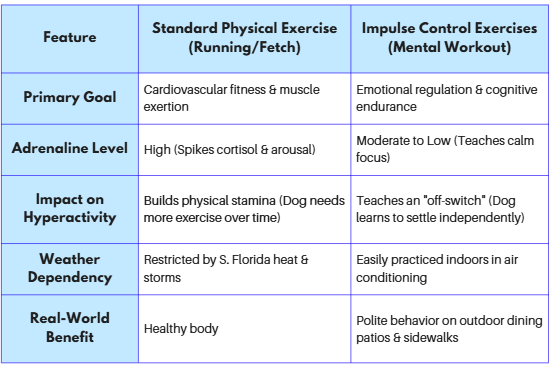
Comparison: Physical Exercise vs. Impulse Control Exercises

chart comparing standard exercise for dogs versus impulse control exercises. It is a useful tool to use when understanding how to train your dog or puppy.

When to Partner with a Professional Dog Trainer in Broward & Palm Beach Counties

While these 15 exercises form a solid foundation, every dog is an individual. High-energy working breeds, young puppies, or dogs showing reactivity, resource guarding, or severe impulse control deficits often require a customized training plan.

Working with a local, certified professional dog trainer ensures:

  • Customized Pace: Moving through exercise criteria without frustrating your dog or causing regression.

  • Real-World Proofing: Guided training trips to high-distraction environments like Mizner Park in Boca Raton, the Deerfield Beach pier, or Las Olas Boulevard in Fort Lauderdale.

  • Safety First: Ensuring proper gear selection and handler mechanics when working with powerful, high-drive breeds.

Whether you live in Deerfield Beach, Boca Raton, Delray Beach, Fort Lauderdale, Pompano Beach, or Lighthouse Point, professional impulse control training turns a chaotic pet dynamic into an effortless partnership.

Transform Your High-Energy Dog Today

Teaching impulse control is not about suppressing your dog's personality or drive—it is about giving them the emotional tools to navigate a complex world safely. By turning daily routines like mealtimes, door openings, and play sessions into impulse control opportunities, your high-energy dog will transform into a calm, confident, and polite companion ready for any South Florida adventure.

Start with 5 to 10 minutes of dedicated impulse control training twice a day, remain consistent, and enjoy the peace of mind that comes with a well-mannered dog!


Ready to help your hyper dog thrive?

Serving Broward and Palm Beach counties with two decades of certified master-level expertise, Canine Intuition Dog Training helps energetic dogs relax and obey.

Contact our team today to schedule a professional evaluation!

How Intune Dog Training Helps You Read Your Dog and Fix Common Behavior Problems

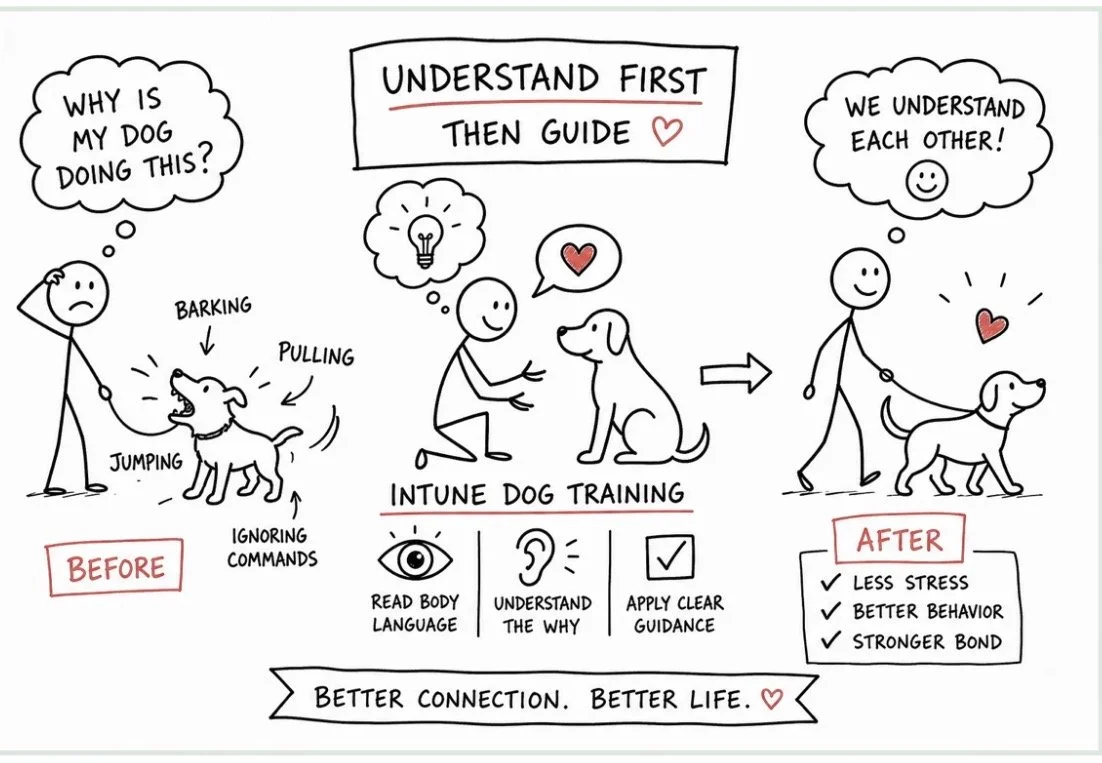
Infographic explaining that you have to understand your dog first before you can successfully command then  them.

Intune dog training starts with a skill most people never develop: learning to read what your dog is actually communicating before you ask anything of them. You've watched the YouTube videos. You've tried the treats, the firm voice, the well-meaning advice from the neighbor whose dog is somehow perfect. And still, your dog pulls on leash, shuts down mid-session, or reacts to things that seem completely random. The frustration is real. But the problem usually isn't your dog.

Many training approaches skip this first step entirely, jumping straight to commands without understanding what the dog is already saying through posture, eye movement, breathing, and a dozen other signals most owners don't know to look for. That foundation changes everything about what comes next.

At Canine Intuition, this idea shapes every program we run across Broward and Palm Beach Counties. Whether it's a first-time puppy evaluation or a multi-week board and train for serious reactivity, the work always starts with observation. This article walks through how that intune dog training approach works in practice and what it looks like across different dogs and different goals.

What Intune Dog Training Actually Means

Getting in tune with your dog is not a metaphor. It's a specific skill set: learning to read the behavioral and emotional signals your dog sends constantly, often before any problem behavior ever surfaces. Body posture, ear position, tail carriage, eye softness, yawning, lip licking, pacing. These signals are happening all the time. Most owners walk right past them.

Much basic obedience guidance starts with commands. Sit. Stay. Leave it. But if your dog is already over threshold, already in a stress response, already shutting down, none of those commands will land the way you expect. The dog isn't being stubborn. They're telling you something, and the training isn't designed to hear it.

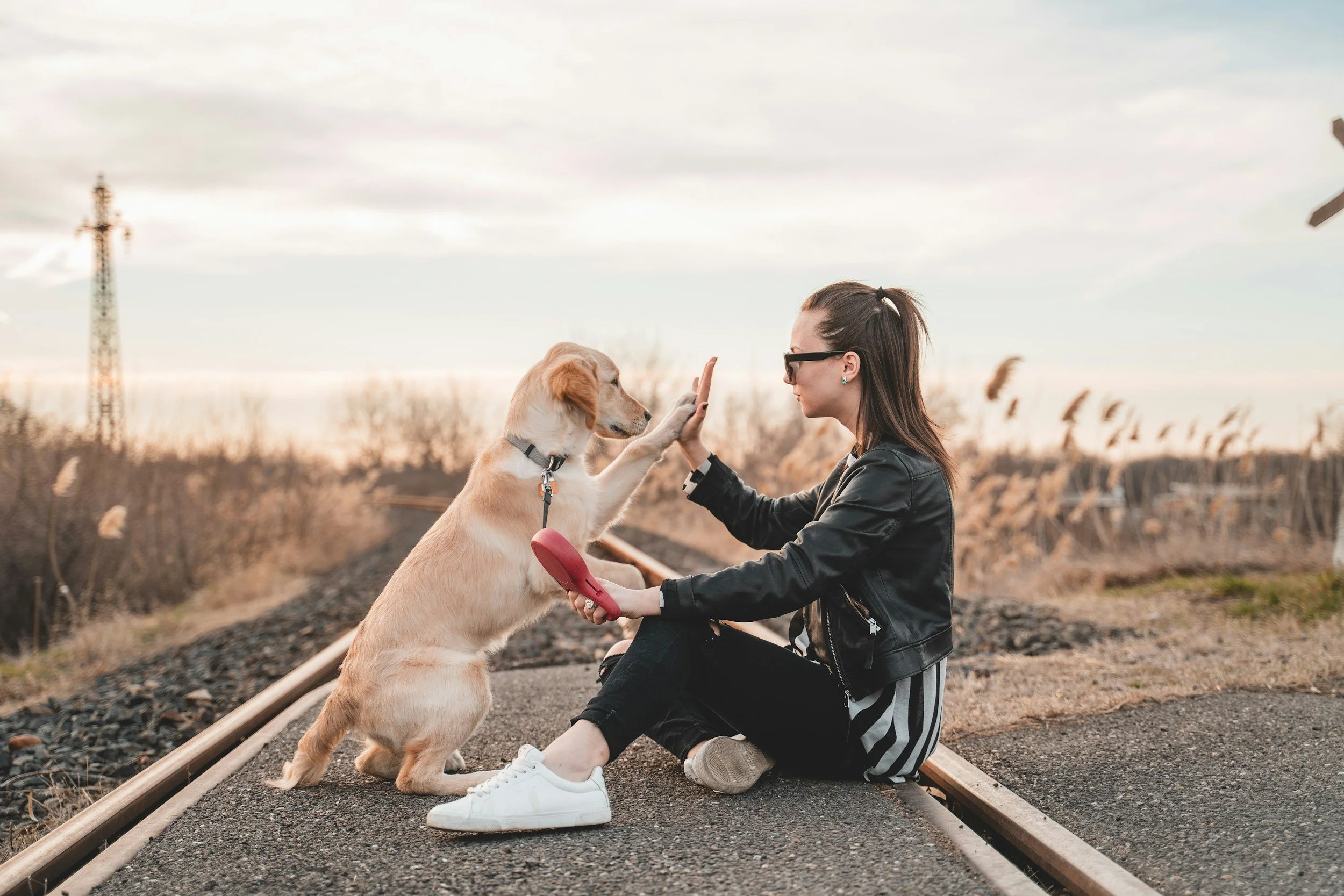
a golden retriever and her owner sitting paw to hand showing the importance of being in tune with your dog. Canine Intuition helps dog owners in South Florida form better bonds with their dogs.

What Your Dog Is Saying Before You Ever Ask for a Sit

The dog who "looks guilty" when you come home is not guilty. They're reading your body language and shutting down from anticipatory fear. The dog who "acts stubborn" during a training session is often overstimulated, and the brain's ability to process new information has hit a ceiling. When a dog "won't listen" in a busy environment, they're most likely in a stress response, not a defiance response, and repeating the cue louder doesn't change that.

Behavior is always communication. Every freeze, every yawn, every lip lick, every whale eye is information. Getting in tune starts with learning to read that information accurately before you ask your dog to do anything else. Once you can do that, the work gets a lot cleaner.

Why One-Way Training Creates Resistance

Training that skips this layer tends to produce two recognizable outcomes: disengagement or escalating reactivity. When a dog is repeatedly asked to perform while their stress signals go unnoticed, they either shut down entirely or the pressure builds into something harder to manage. Animal welfare research consistently shows that unmanaged stress during training correlates with poorer outcomes and increased reactive behavior. Neither result is what anyone signed up for.

Reading your dog first doesn't slow training down. It actually speeds things up, because the dog is in a state where real learning can happen. Cooperation follows clarity, not the other way around.

The Core Techniques Behind Intune Dog Training

A reward-based approach with clear structure isn't about being permissive, and it's not about loading on corrections until a dog complies. It uses positive reinforcement as the primary communication tool while giving dogs the consistent feedback they need to feel safe. Fear-free handling principles are built in from the start, which means we're always working to keep the dog below threshold, not pushing through it.

The goal is a dog who works with you because the communication makes sense to them. Building that kind of cooperation looks like a dog that checks in voluntarily, offers calm behavior at the door, and settles without repeated cuing, not one who complies out of uncertainty about what happens if they don't.

Reward-Based Communication That Actually Sticks

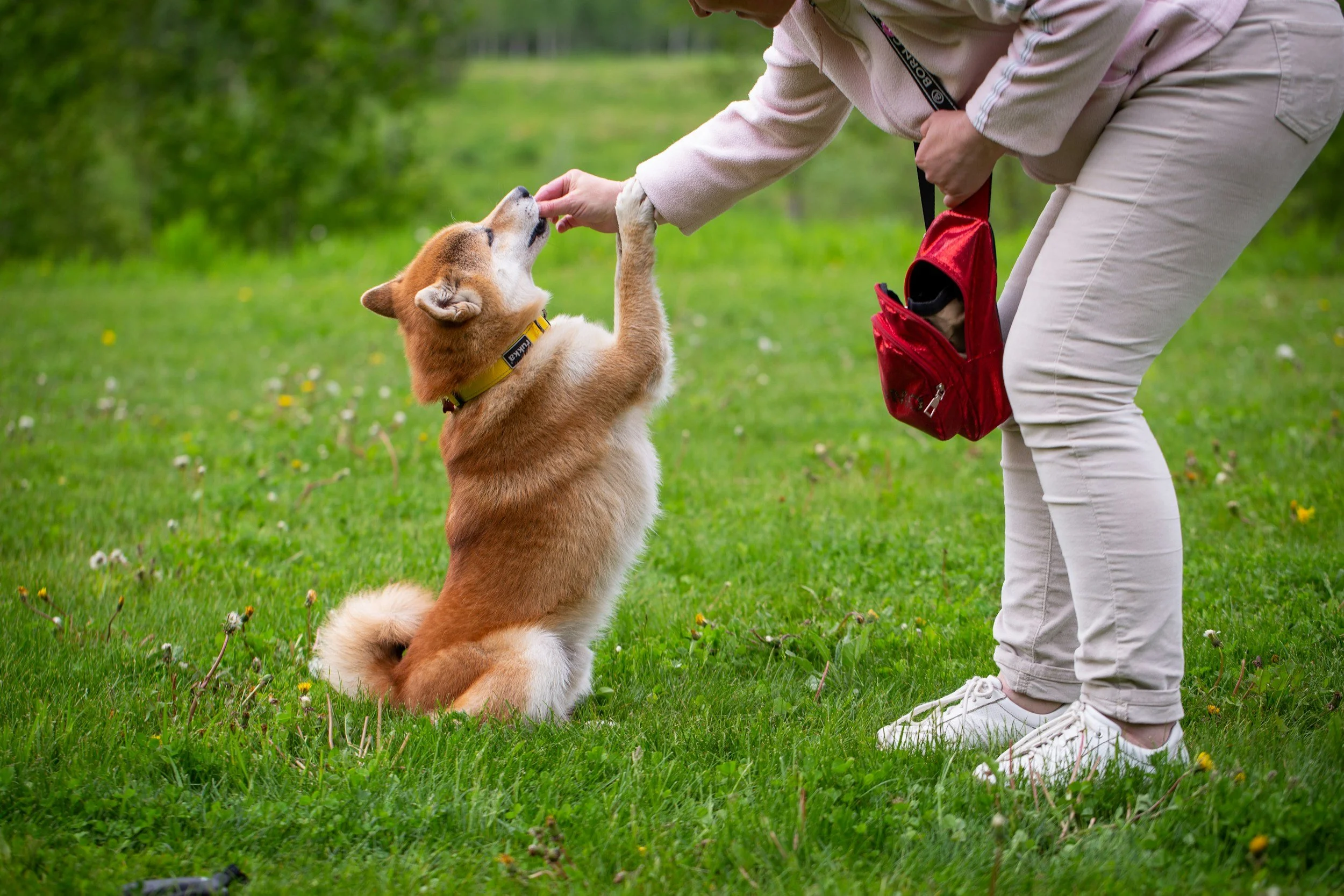
Shiatsu dog getting rewarded for listening to it's owner.

Marker training is the practical engine here. Whether you use a verbal marker like "yes" or a clicker, the principle is the same: the dog needs to know exactly which behavior earned the reward. Timing matters more than most people realize. A reward delivered two seconds late marks a completely different behavior than the one you intended to reinforce, a well-documented principle in applied behavioral learning.

The reward itself matters less than most owners assume. For many dogs, real-world access, play, or movement is more motivating than food in certain contexts. What actually drives results is precision and consistency in the communication loop, not the size of the treat.

Structure and Consistency as a Form of Kindness

Most owners expect rules to create more tension, not less. But dogs living in chaotic or unpredictable environments tend to be more reactive, harder to train, and slower to build confidence, a pattern supported by animal behavior research linking predictability with reduced anxiety and improved learning. Rules are not restrictions. They're a form of clarity, and clarity is what lets a dog relax.

A dog that knows what to expect is a dog that can actually learn. Structure, applied consistently and calmly, is one of the most effective tools in any behavior modification program. Think of it as giving your dog a map instead of dropping them in a maze.

Which Dogs Benefit Most from This Approach

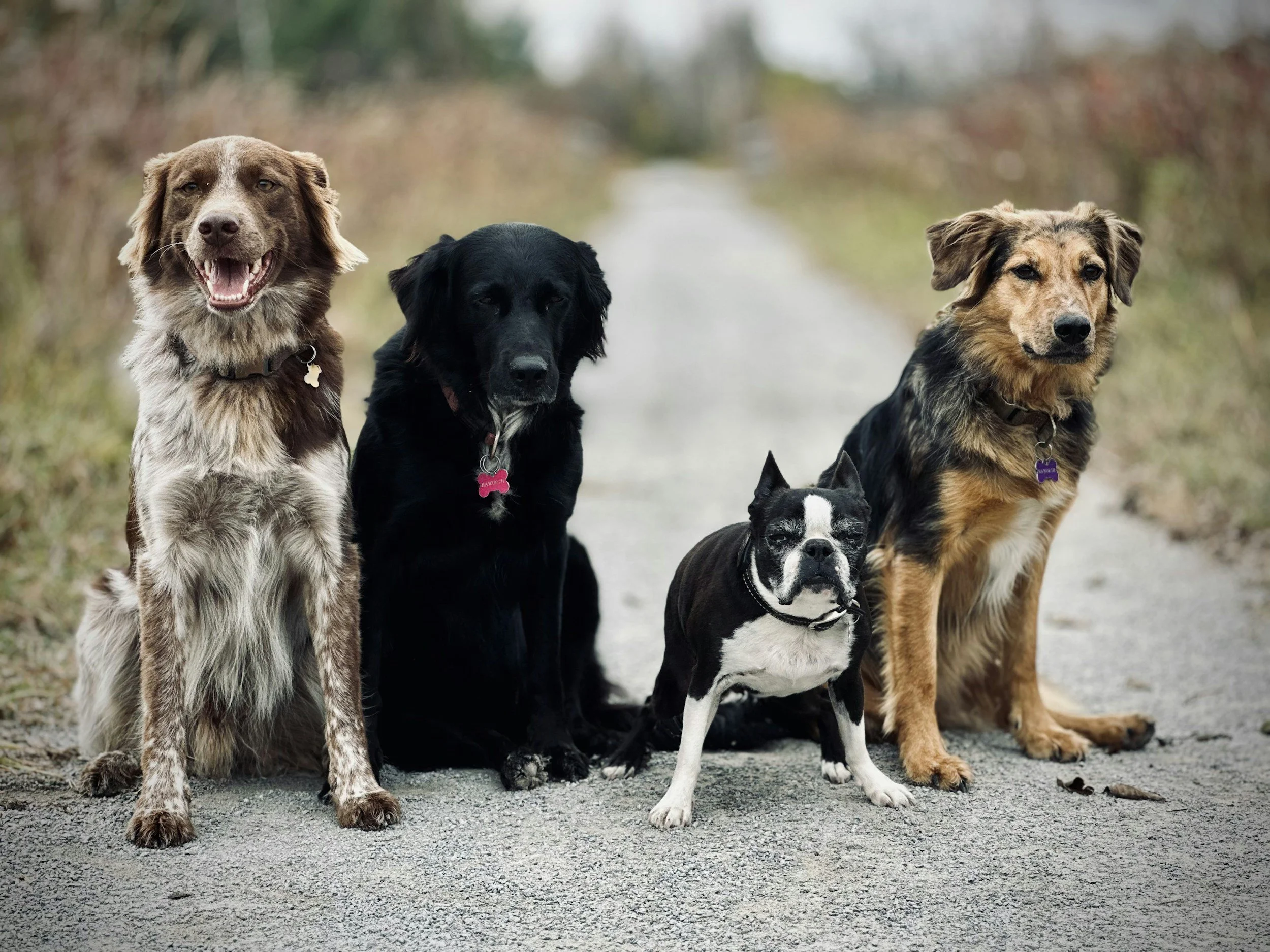
four different breed of dogs show a variety of dogs can experience successful command training in the Broward area.

Not all dogs need the same entry point. Puppies still forming habits, rescue dogs carrying behavioral history they can't explain, and reactive dogs who've been misread for too long each benefit significantly when training starts with genuine observation, for different reasons and in different ways.

Puppies: Building the Right Foundation Early

Puppies are still forming habits, which means early training has a disproportionate impact on adult behavior. The socialization window closes faster than most people expect, and what a puppy learns to do and not do during that period shapes their responses for years. Starting with observation-based puppy training during that window prevents the most common adult behavior problems before they have a chance to develop.

At Canine Intuition, early puppy evaluations assess what the pup is already communicating alongside what they still need to learn. Catching stress signals early and addressing them alongside basic skills is what separates a confident adult dog from one that struggles with new environments.

Rescue Dogs and Reactive Dogs: Rewriting the Script

Rescue dogs often arrive with fear responses, resource guarding, or aggression rooted in experiences no one can fully explain. The second sentence in many of these cases runs the same way: over time, reactivity became the only available coping mechanism, because no one ever taught the dog how to process a stimulating environment differently.

Both profiles improve significantly when training starts with the owner learning to read the dog's state first. Once you understand what's driving the behavior, you can work with it instead of against it. Early measurable progress often shows up within four to eight weeks with consistent work. Meaningful stabilization typically takes three to six months.

Simple Practices to Start Building This Skill at Home

You don't need to wait for a trainer to start this. There are specific daily practices that develop the observation skills owners need to become better partners to their dogs. These don't require equipment, special knowledge, or a lot of time.

The Daily 5-Minute Observation Window

Sit with your dog in a calm space. Say nothing. Do nothing. Just watch. Notice their breathing rate, where they choose to position their body, whether they seek eye contact or avoid it. Notice whether their mouth is relaxed or tight, whether their ears are soft or forward and fixed.

Do this once a day for a week. You'll start to see your dog's baseline clearly, and that baseline becomes the reference point for everything else you observe. When something is off, you'll actually notice it instead of guessing.

One Request, One Reward: Simplifying Your Communication Loop

Most owners repeat commands multiple times before getting a response. Sit. Sit. Siiit. The problem is that repetition teaches the dog the first cue doesn't require action. Clean that up with a simple rule: one cue, then wait. If the dog doesn't respond, the cue wasn't clear yet, or the environment was too distracting. Address that, then try again.

When the behavior happens, reward it immediately and precisely. This one adjustment alone changes how clearly dogs understand what's being asked of them, and it's something any owner can implement the same day they learn it.

Private Lessons vs. Board and Train: Picking the Right Format

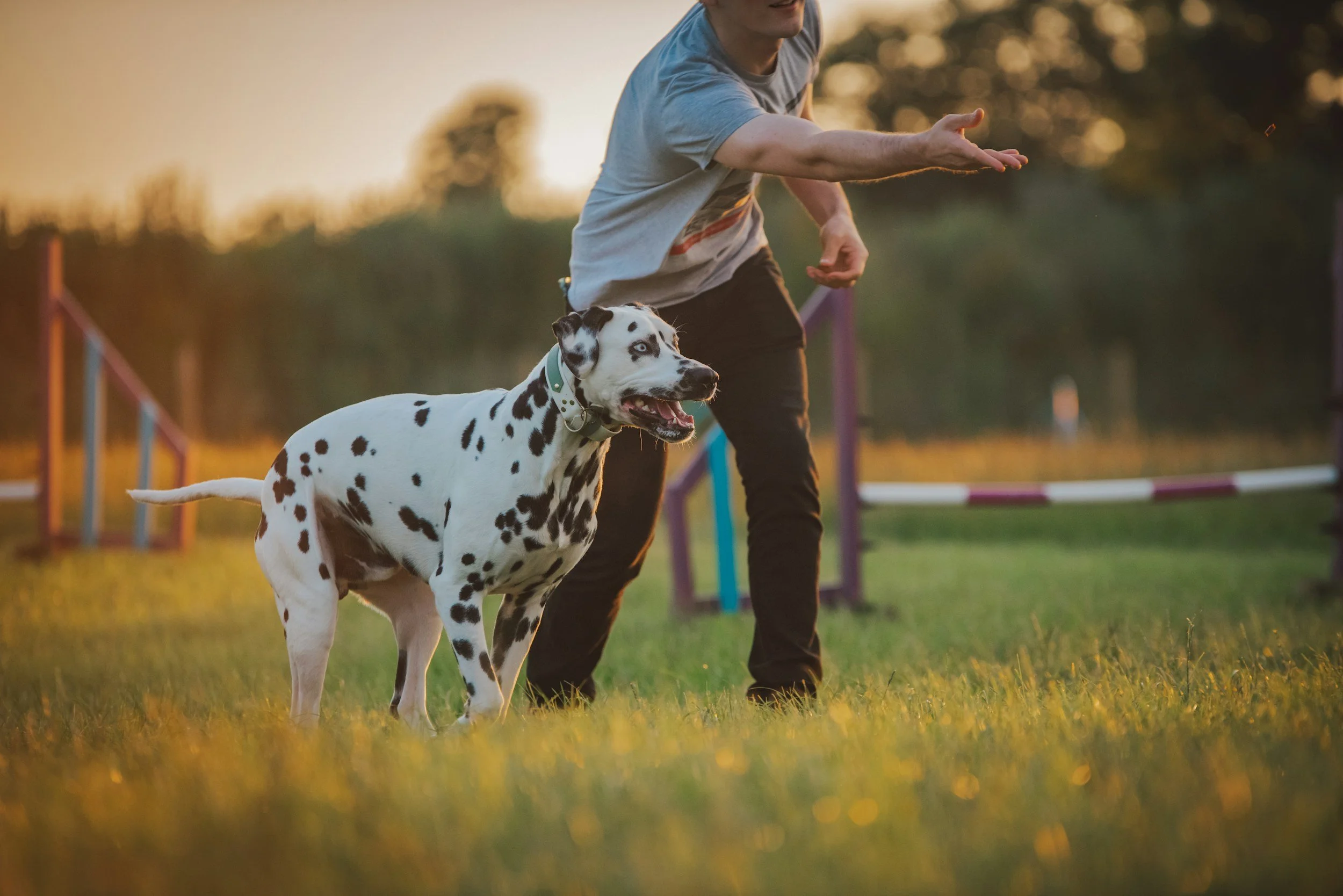
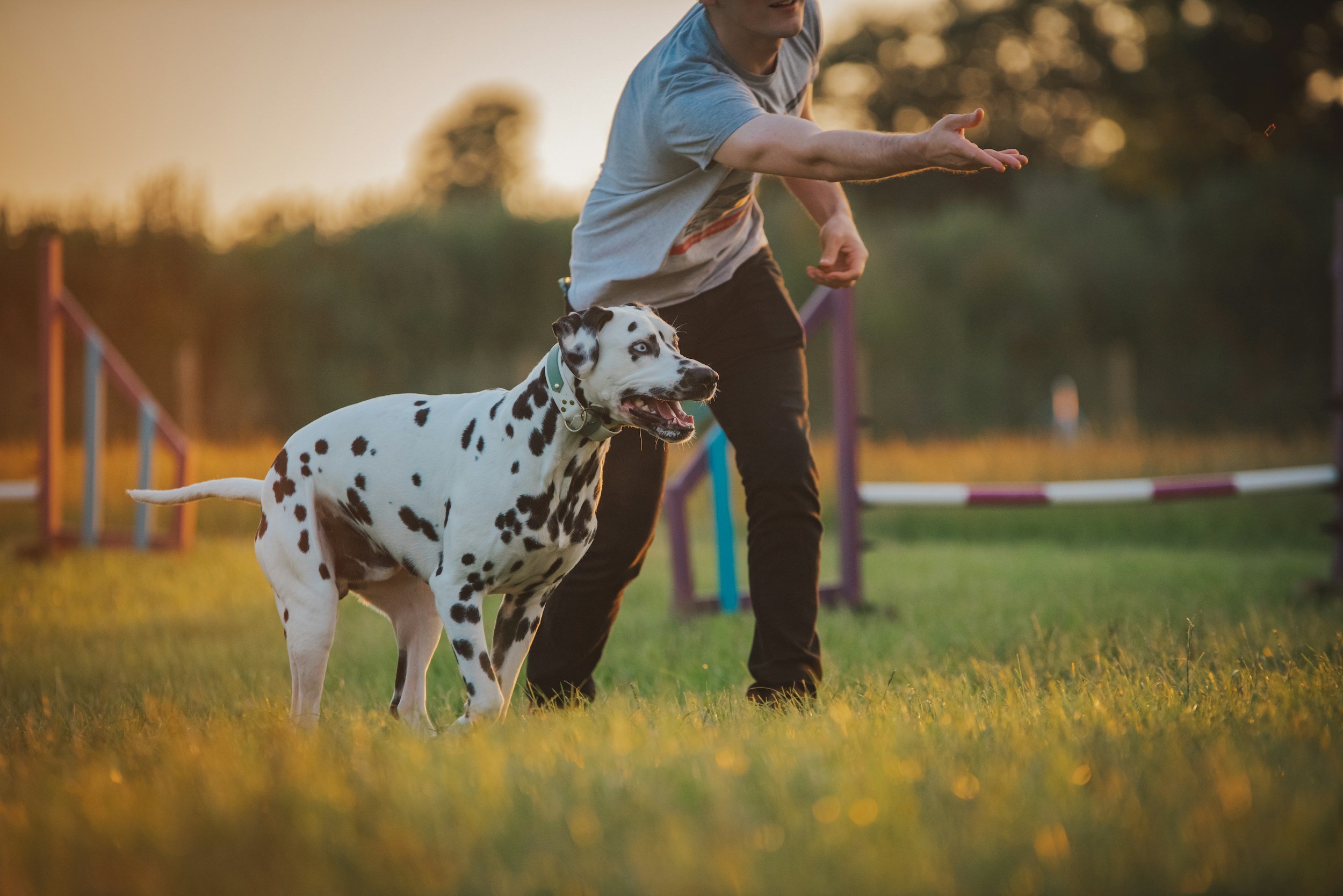
dalmation dog being trained in Deerfield Beach,  to obey commands.

The approach is the same regardless of format. What changes is the pace, the environment, and who carries the training load day to day. Here's an honest breakdown so you can self-select based on your situation.

Private One-on-One Lessons: Best for Mild to Moderate Issues

Private lessons work well for dogs with manageable behavioral challenges: leash pulling, jumping, gaps in basic obedience, early reactivity. They also work well for owners who want to develop their own handling skills alongside the dog. Over six to twelve weeks, the dog and owner build fluency together in the actual environment where most of their life happens.

This format tends to produce strong long-term retention because the owner is doing the work in real time, in the real context. The training generalizes naturally because it's happening at home from the start.

Board and Train: When Immersion Changes Everything

For dogs with serious reactivity, aggression, or anxiety that hasn't responded to other approaches, a residential board and train program changes the equation. Daily, repeated, professionally managed training in a structured environment accelerates change in ways that weekly sessions can't match. Programs commonly run two to four weeks, and early improvements are often visible within the first several days to a couple of weeks depending on the dog.

The transfer work after pickup is critical. The best outcomes consistently come from pairing a board and train with follow-up private coaching at home, so the dog generalizes new behavior into real-world settings with their owner leading the way. The program builds the foundation; the owner maintains it.

How Canine Intuition Works with South Florida Dogs

At Canine Intuition, we've spent decades applying this intune dog training approach with hundreds of dogs across Broward and Palm Beach Counties. The work isn't generic and it doesn't start with a sales pitch. It starts with a behavioral evaluation that gives us a real picture of what the dog is communicating and where the owner's observation skills have gaps.

One anonymized case from Broward County: a rescue dog who arrived with separation anxiety and resource guarding, history mostly unknown. Three weeks in a structured residential program, followed by private coaching with the owner, built a predictable daily routine that the owner reported holding six months later. From Palm Beach County: a reactive adolescent whose owner learned to read stress signals early enough to interrupt the escalation cycle before it peaked. Within eight weeks, the owner was managing trigger encounters that had previously been overwhelming for both of them.

What Happens When You Book an Evaluation with Us

The evaluation is a working session, not a meet-and-greet. We assess the dog's communication patterns, identify the gaps in how the owner is reading them, and build a clear picture of what's actually driving the behavior. You walk away with a real plan, not a brochure.

If you're in Broward or Palm Beach County and want professional support building this skill alongside your dog, reach out to Canine Intuition to schedule your evaluation. The first step is simply showing up and letting us take a real look together.

Most Behavior Problems Are Communication Problems

That's the core of it. Not technique problems. Not breed problems. Not stubbornness or spite. Many of the most common behavior issues trace back to a dog saying something clear that the owner doesn't yet have the language to hear. That's a solvable problem.

Intune dog training, reading the signals your dog is already sending, adjusting your communication to meet them where they are, is what makes training stick. Whether you're working through early puppy habits, rehabbing a rescue, or managing reactivity that's been building for months, observation is where the work starts. Once you see your dog clearly, everything else moves faster and holds longer.

If you're ready to build that foundation with professional guidance, Canine Intuition is here for you!

Book an evaluation today and let's take a real look at what your dog is telling you.

Magic Bullet or Money Pit? The Unfiltered Truth About Board & Train

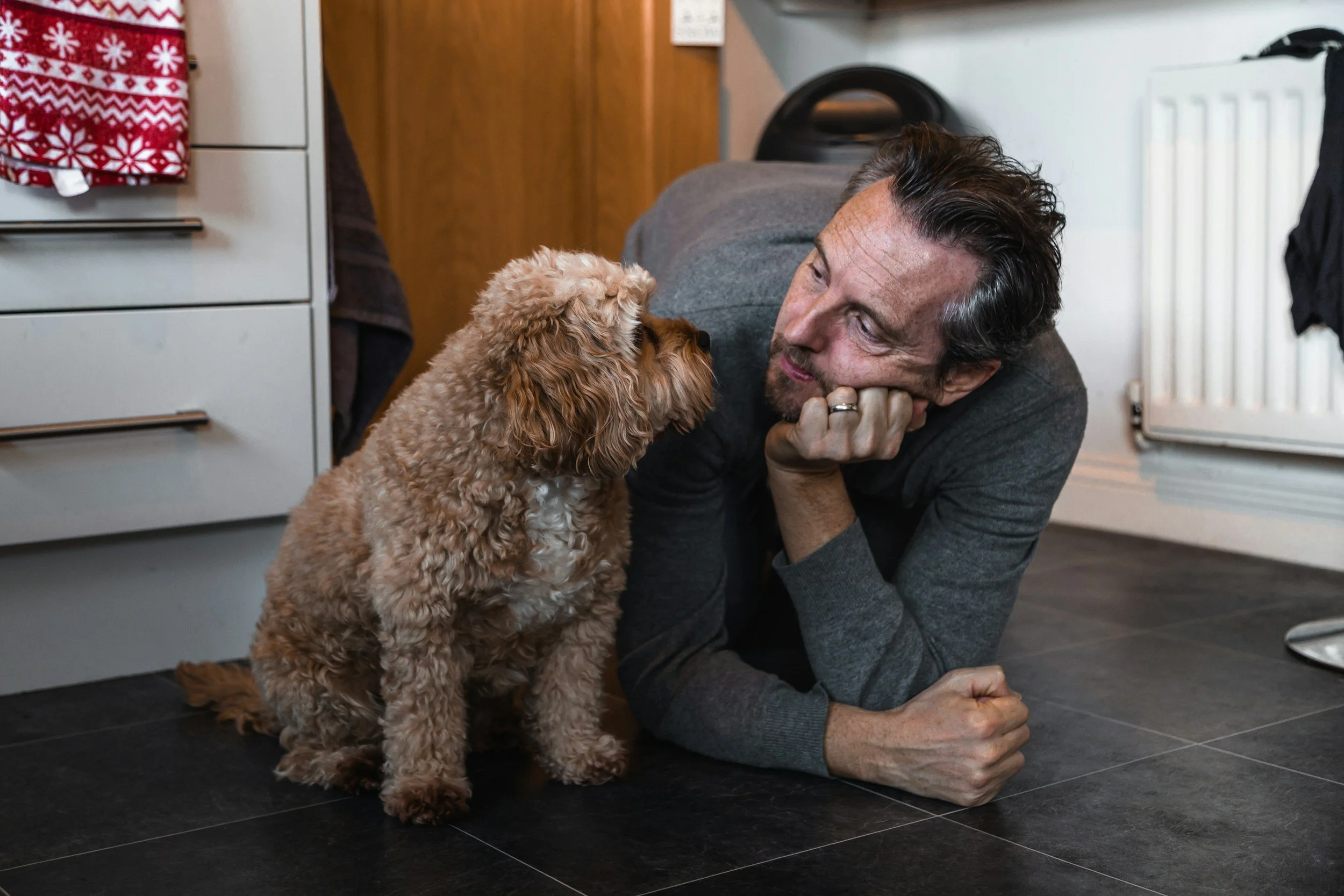
A confused dog owner looking at his dog trying to figure out if board training is a right fit for his canine.

The dream is undeniably tantalizing: you drop off your four-legged chaos agent for a few weeks, and you pick up a polished, serene angel who greets dinner guests with a polite nod, heels seamlessly past distractions, and practically folds your laundry.

Picture this: you’re sitting at a dog-friendly bistro on Las Olas Boulevard in Fort Lauderdale or Atlantic Avenue in Delray Beach. Suddenly, a brave South Florida iguana darts across the sidewalk. Your 80-pound rescue dog lunges, turning your iced latte into a lap pool and dragging you across the concrete plaza. As you pick up your shattered pride, you find yourself staring at your phone at 2:00 AM, desperately searching for "dog boot camps near me."

It sounds like canine Hogwarts. But is a Board and Train program actually worth your hard-earned money, or is it just an overpriced resort stay with a fancy title?

After 20 years of training dogs across Broward and Palm Beach counties—holding the highest certifications in the industry—we at Canine Intuition Dog Training have seen the good, the bad, and the outright ridiculous. Here is the ultimate, unfiltered, and deeply practical guide to whether a Board and Train program is worth the investment for you and your dog.

What Exactly IS a Board and Train Program?

A true Board and Train program is not doggy daycare with a few "sits" tossed in during potty breaks. Nor is it standard kennel boarding where a dog sits in a crate for 23 hours a day.

A reputable Board and Train program is an intensive behavioral immersion experience. Your dog lives directly with or under the constant supervision of professional trainers. Every interaction—from morning walks to feeding time, crate entrance, threshold manners, and evening downtime—is leveraged as a learning opportunity. It is the canine equivalent of sending a student to an immersive language institute in Spain rather than having them take Spanish once a week for 45 minutes.

The Good: Why Board & Train Delivers Massive Results

When executed by master-level professionals, an immersive training program is unequivocally the fastest way to modify behavior and build solid obedience.

  • 24/7 Behavioral Consistency: Dogs are efficiency machines. If they can find a loophole in your enforcement 50% of the time, they will exploit it. In an immersive environment, loopholes don't exist. Professionals maintain strict boundaries around the clock, meaning bad habits are instantly interrupted and correct behaviors are reinforced hundreds of times a day.

  • Professional Mechanics and Split-Second Timing: Dog training is a physical skill that relies heavily on muscle memory, leash handling, body language, and split-second timing. The average owner rewards or corrects a behavior two to three seconds too late, accidentally reinforcing the wrong action. Professional trainers catch micro-behaviors instantly, communicating with pinpoint accuracy so the dog learns ten times faster.

  • Real-World Proofing in Distraction-Heavy Environments: Teaching a dog to sit in a quiet living room in Boca Raton is easy. Teaching that same dog to hold a "Place" command while kids rollerblade past at a park in West Palm Beach requires serious proofing. A quality Board and Train program takes your dog directly into high-distraction, real-world environments—busy outdoor plazas, parks, shopping districts, and crowded streets—building real neutrality and focus under pressure.

  • Heavy Lifting and Habit Breaking Done for You: Reversing deeply ingrained behaviors like leash reactivity, resource guarding, severe counter-surfing, or persistent door-darting takes immense physical and emotional energy. Letting an experienced trainer break the cycle and build the new neural pathways saves owners months of raw frustration and physical exhaustion.

A certified master dog trainer practicing loose-leash walking with a dog outdoors in Palm Beach, Florida.

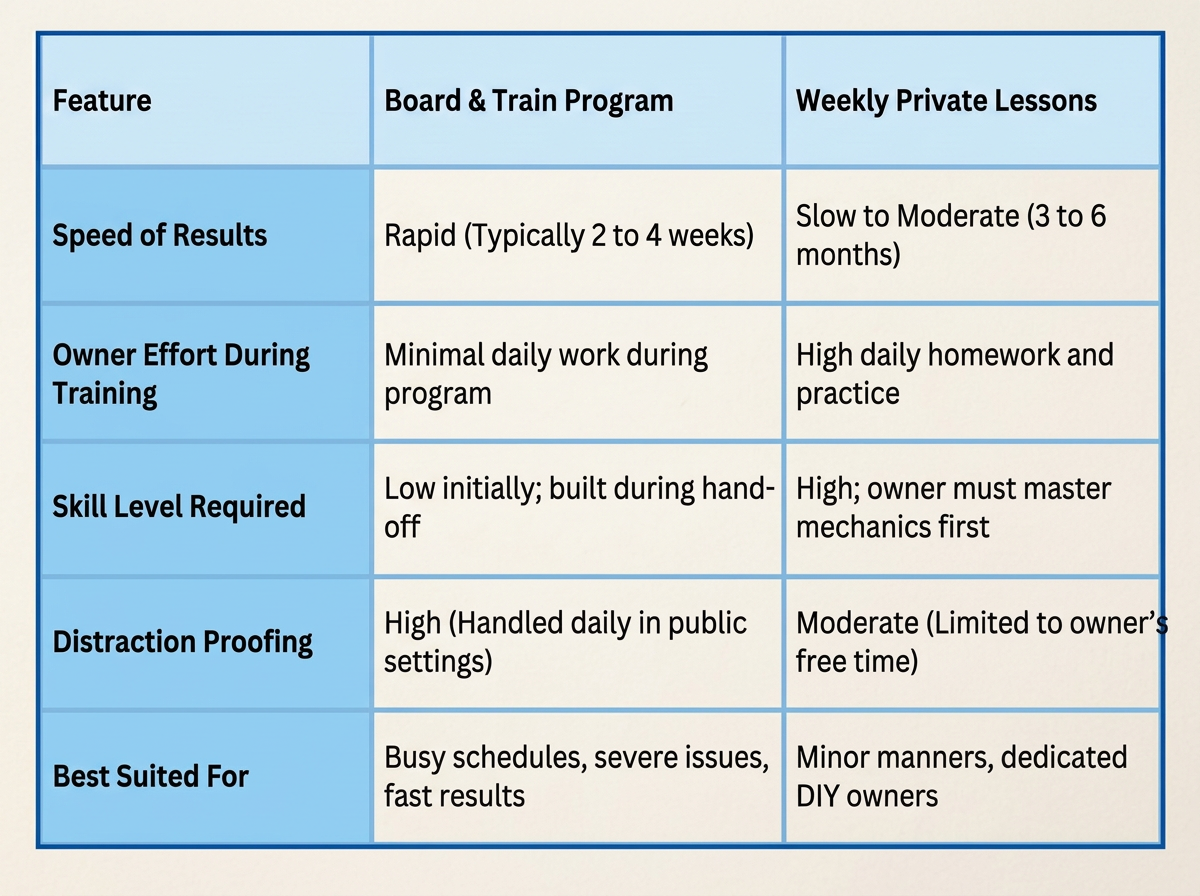
Comparing Options: Board & Train vs. Weekly Private Lessons

The Catch: What Bad Trainers Won't Tell You

If Board and Train were a magical cure-all, every dog on the block would be a perfect gentleman. The reality is that Board and Train programs carry significant risks if you choose the wrong facility.

  • The "Owner Transfer" Trap: A master trainer can get your dog walking like a pristine show champion in ten days. But dogs don't respect titles; they respect handling. If the facility does not invest heavily in teaching you how to handle your dog, your pup will revert to old habits the moment they step back onto your tile floors in Broward County.

  • The Wild West of the Dog Training Industry: Did you know that the dog training industry is almost entirely unregulated? Literally anyone can buy a leash, print a business card, and claim to run a "dog boot camp." Uncertified, inexperienced trainers often rely heavily on harsh, unvetted methods or extreme isolation, resulting in dogs that are either terrified, shut down, or temporarily suppressed rather than genuinely trained.

  • Context Shock and Generalization Deficits: Dogs are contextual learners. They associate rules with specific places and specific people. A dog might understand that barking at cars is forbidden at a pristine training facility, but assume the rule doesn't apply when they are back home in Palm Beach with their favorite human. Without structured transition lessons in your home environment, context shock can erase weeks of progress.

What 20 Years of Experience Taught Us

At Canine Intuition Dog Training, we have spent two decades refining our approach across South Florida. We hold the highest industry certifications because we believe dogs and their owners deserve science-backed, balanced, and humane training methodologies that actually hold up in the real world.

Board and Train is not a substitute for owner involvement—it is an accelerated launchpad.

You aren’t just paying for someone to train your dog; you are paying to skip the grueling, frustrating trial-and-error phase. The true magic of our program doesn't happen when we have your dog—it happens during our comprehensive hand-off and transition lessons. We don't just hand you a leash and say "good luck." We coach you, fine-tune your body language, test you in real-world scenarios, and provide ongoing support so that the respect and focus we built with your dog transfers seamlessly to you.

A well-behaved dog at a pet-friendly beach in Broward County after completing a balanced board and train program.

The Ultimate Insider Checklist: How to Choose a Board & Train

  • Check Credentials: Ask for verified, recognized national certifications—not self-proclaimed titles or weekend workshop certificates.

  • Inspect Hand-Off Commitment: Ensure the program includes at least 2–3 structured, hands-on transfer sessions with you before completion.

  • Review Living Conditions: Tour the facility or home where your dog will sleep and train. Avoid warehouse-style kennels where dogs sit in crates for 20+ hours a day.

  • Confirm Post-Graduation Support: Choose a facility that offers follow-up lessons, refreshers, or phone support to protect your long-term investment.

Is Board and Train Worth It for You?

If you are struggling with severe behavioral issues, possess a busy work schedule that leaves little time for hours of daily reps, or simply want a public-ready companion who can handle the vibrant, high-distraction lifestyle of South Florida, Board and Train is worth every single penny.

However, it is only worth it if you pair your investment with a certified, battle-tested team that prioritizes fair communication, real-world proofing, and thorough owner education.

Ready to transform your chaotic canine into a calm, confident companion?

Serving Broward and Palm Beach counties with 20 years of elite expertise, Canine Intuition Dog Training turns real-world distractions into lifelong obedience.

Contact our team today to schedule an evaluation and discover the ideal training path for your family!