The dream is undeniably tantalizing: you drop off your four-legged chaos agent for a few weeks, and you pick up a polished, serene angel who greets dinner guests with a polite nod, heels seamlessly past distractions, and practically folds your laundry.
Picture this: you’re sitting at a dog-friendly bistro on Las Olas Boulevard in Fort Lauderdale or Atlantic Avenue in Delray Beach. Suddenly, a brave South Florida iguana darts across the sidewalk. Your 80-pound rescue dog lunges, turning your iced latte into a lap pool and dragging you across the concrete plaza. As you pick up your shattered pride, you find yourself staring at your phone at 2:00 AM, desperately searching for "dog boot camps near me."
It sounds like canine Hogwarts. But is a Board and Train program actually worth your hard-earned money, or is it just an overpriced resort stay with a fancy title?
After 20 years of training dogs across Broward and Palm Beach counties—holding the highest certifications in the industry—we at Canine Intuition Dog Training have seen the good, the bad, and the outright ridiculous. Here is the ultimate, unfiltered, and deeply practical guide to whether a Board and Train program is worth the investment for you and your dog.
What Exactly IS a Board and Train Program?
A true Board and Train program is not doggy daycare with a few "sits" tossed in during potty breaks. Nor is it standard kennel boarding where a dog sits in a crate for 23 hours a day.
A reputable Board and Train program is an intensive behavioral immersion experience. Your dog lives directly with or under the constant supervision of professional trainers. Every interaction—from morning walks to feeding time, crate entrance, threshold manners, and evening downtime—is leveraged as a learning opportunity. It is the canine equivalent of sending a student to an immersive language institute in Spain rather than having them take Spanish once a week for 45 minutes.
The Good: Why Board & Train Delivers Massive Results
When executed by master-level professionals, an immersive training program is unequivocally the fastest way to modify behavior and build solid obedience.
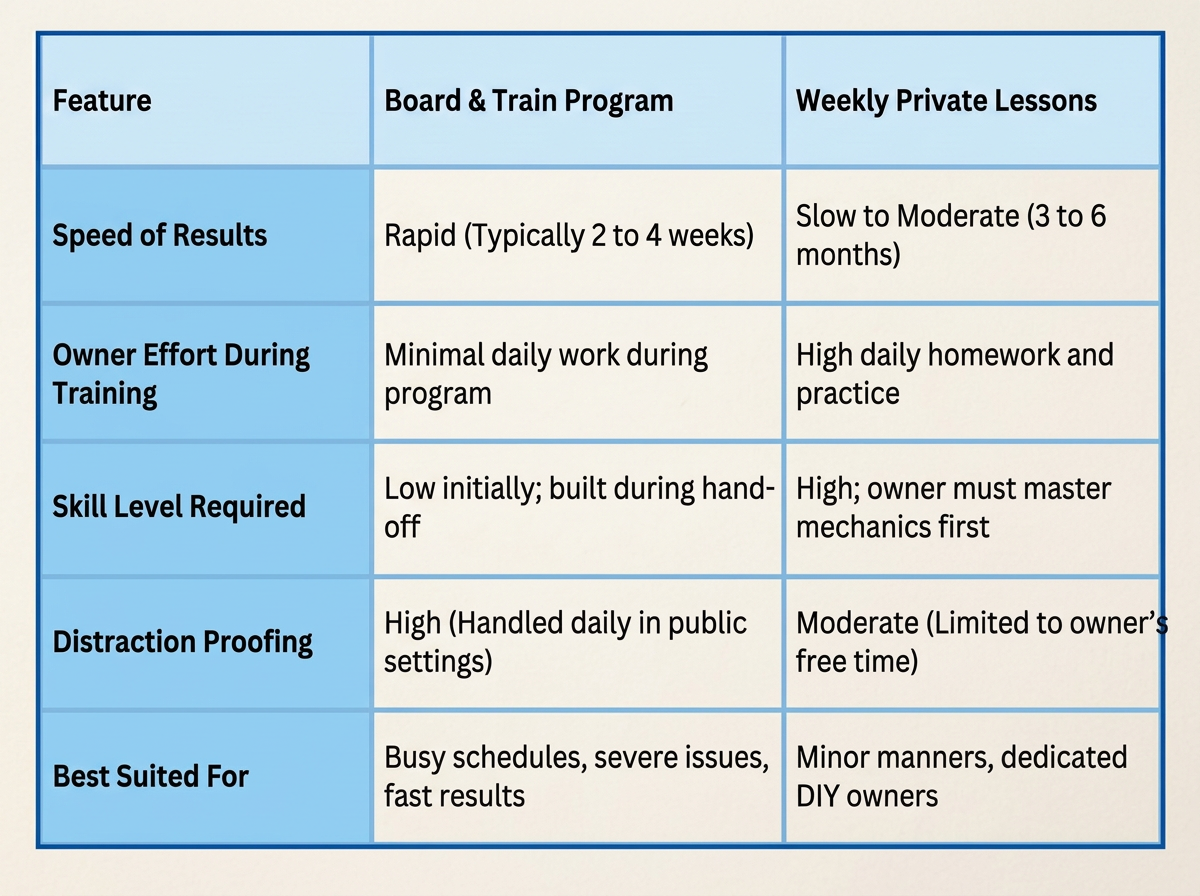
24/7 Behavioral Consistency: Dogs are efficiency machines. If they can find a loophole in your enforcement 50% of the time, they will exploit it. In an immersive environment, loopholes don't exist. Professionals maintain strict boundaries around the clock, meaning bad habits are instantly interrupted and correct behaviors are reinforced hundreds of times a day.
Professional Mechanics and Split-Second Timing: Dog training is a physical skill that relies heavily on muscle memory, leash handling, body language, and split-second timing. The average owner rewards or corrects a behavior two to three seconds too late, accidentally reinforcing the wrong action. Professional trainers catch micro-behaviors instantly, communicating with pinpoint accuracy so the dog learns ten times faster.
Real-World Proofing in Distraction-Heavy Environments: Teaching a dog to sit in a quiet living room in Boca Raton is easy. Teaching that same dog to hold a "Place" command while kids rollerblade past at a park in West Palm Beach requires serious proofing. A quality Board and Train program takes your dog directly into high-distraction, real-world environments—busy outdoor plazas, parks, shopping districts, and crowded streets—building real neutrality and focus under pressure.
Heavy Lifting and Habit Breaking Done for You: Reversing deeply ingrained behaviors like leash reactivity, resource guarding, severe counter-surfing, or persistent door-darting takes immense physical and emotional energy. Letting an experienced trainer break the cycle and build the new neural pathways saves owners months of raw frustration and physical exhaustion.
Comparing Options: Board & Train vs. Weekly Private Lessons
The Catch: What Bad Trainers Won't Tell You
If Board and Train were a magical cure-all, every dog on the block would be a perfect gentleman. The reality is that Board and Train programs carry significant risks if you choose the wrong facility.
The "Owner Transfer" Trap: A master trainer can get your dog walking like a pristine show champion in ten days. But dogs don't respect titles; they respect handling. If the facility does not invest heavily in teaching you how to handle your dog, your pup will revert to old habits the moment they step back onto your tile floors in Broward County.
The Wild West of the Dog Training Industry: Did you know that the dog training industry is almost entirely unregulated? Literally anyone can buy a leash, print a business card, and claim to run a "dog boot camp." Uncertified, inexperienced trainers often rely heavily on harsh, unvetted methods or extreme isolation, resulting in dogs that are either terrified, shut down, or temporarily suppressed rather than genuinely trained.
Context Shock and Generalization Deficits: Dogs are contextual learners. They associate rules with specific places and specific people. A dog might understand that barking at cars is forbidden at a pristine training facility, but assume the rule doesn't apply when they are back home in Palm Beach with their favorite human. Without structured transition lessons in your home environment, context shock can erase weeks of progress.
What 20 Years of Experience Taught Us
At Canine Intuition Dog Training, we have spent two decades refining our approach across South Florida. We hold the highest industry certifications because we believe dogs and their owners deserve science-backed, balanced, and humane training methodologies that actually hold up in the real world.
Board and Train is not a substitute for owner involvement—it is an accelerated launchpad.
You aren’t just paying for someone to train your dog; you are paying to skip the grueling, frustrating trial-and-error phase. The true magic of our program doesn't happen when we have your dog—it happens during our comprehensive hand-off and transition lessons. We don't just hand you a leash and say "good luck." We coach you, fine-tune your body language, test you in real-world scenarios, and provide ongoing support so that the respect and focus we built with your dog transfers seamlessly to you.

The Ultimate Insider Checklist: How to Choose a Board & Train
Check Credentials: Ask for verified, recognized national certifications—not self-proclaimed titles or weekend workshop certificates.
Inspect Hand-Off Commitment: Ensure the program includes at least 2–3 structured, hands-on transfer sessions with you before completion.
Review Living Conditions: Tour the facility or home where your dog will sleep and train. Avoid warehouse-style kennels where dogs sit in crates for 20+ hours a day.
Confirm Post-Graduation Support: Choose a facility that offers follow-up lessons, refreshers, or phone support to protect your long-term investment.
Is Board and Train Worth It for You?
If you are struggling with severe behavioral issues, possess a busy work schedule that leaves little time for hours of daily reps, or simply want a public-ready companion who can handle the vibrant, high-distraction lifestyle of South Florida, Board and Train is worth every single penny.
However, it is only worth it if you pair your investment with a certified, battle-tested team that prioritizes fair communication, real-world proofing, and thorough owner education.